Science News
 American
Science News for 19 January 2015
American
Science News for 19 January 2015
Mathematical approach provides a new step in resolving the mystery of glass
Phys.org - 19 Jan 2015 15:49 An interdisciplinary team of mathematicians and physicists has developed a new quantitative approach to understanding the mysterious properties of the materials called glasses. The study is described in a paper in the Na...
Scientists tame Schrodinger's cat for a new type of quantum computer
Phys.org - 19 Jan 2015 15:11 Physicists at the University of Sussex have tamed one of the most counterintuitive phenomena of modern science in their quest to develop a new generation of machines capable of revolutionizing the way we can solve many p...
MIT team enlarges brain samples, making them easier to image
e! Science News - 19 Jan 2015 04:03
Beginning with the invention of the first microscope in the late 1500s, scientists have been trying to peer into preserved cells and tissues with ever-greater magnification. The latest generation of so-called "super-reso...
Self-destructive effects of magnetically-doped ferromagnetic topological insulators
Phys.org - 19 Jan 2015 22:00 The discovery of "topologically protected" electrical conductivity on the surface of some materials whose bulk interior acts as an insulator was among the most sensational advances in the last decade of condensed matter ...
New laser could upgrade the images in tomorrow's technology
Phys.org - 19 Jan 2015 22:00 A new semiconductor laser developed at Yale has the potential to significantly improve the imaging quality of the next generation of high-tech microscopes, laser projectors, photolithography, holography, and biomedical i...
Cunning snails drug fish with insulin then eat them
New Scientist - 19 Jan 2015 22:00
Cone snails spray an incapacitating chemical cocktail to knock out fish. And understanding the structure of a fast-working insulin molecule in that cocktail may help inform drug development for diabetes
Rite reasons: Why your brain loves pointless rituals
New Scientist - 19 Jan 2015 22:00
Logic and reason sets our species apart, but we are also born with a mind for nonsensical rituals - and they may be even more crucial for our survival (full text available to subscribers)
New high-speed 3-D microscope -- SCAPE -- gives deeper view of living things
e! Science News - 19 Jan 2015 21:32
Opening new doors for biomedical and neuroscience research, Elizabeth Hillman, associate professor of biomedical engineering at Columbia Engineering and of radiology at Columbia University Medical Center (CUMC), has deve...
Can bitcoin outgun the abuses of big data?
New Scientist - 19 Jan 2015 21:00
If bitcoin-like currencies take off, might people power stop big firms from invading our privacy? A bold thought from crashing together two new books
Soviet Union fall helped drug-resistant TB to take off
New Scientist - 19 Jan 2015 19:54
The first world war helped spread TB round the world, but it was the collapse of the Soviet Union that enabled the multidrug-resistant form to take off
Today on New Scientist
New Scientist - 19 Jan 2015 19:30
All the latest on newscientist.com: eureka moments relived, epic cosmic radio burst seen in real time, anti-obesity implant and more
See chicken develop on drugs through a cracked eggshell
New Scientist - 19 Jan 2015 19:00
Peek inside two eggs containing moving, developing chicks to see how giving one a muscle stimulant can have a life-long effect on its body shape
Working Lab-Grown Human Muscles to Serve as 'Clinical Trials in a Dish'
Singularity Hub - 19 Jan 2015 18:00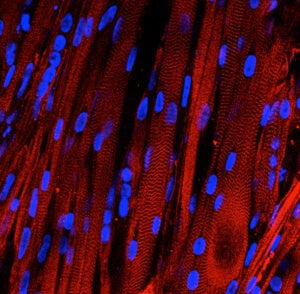 A team of researchers out of Duke University recently announced they've grown human skeletal muscle in a dish. The muscle responds to electrical impulses, biochemical signals, and drugs just like...
Eureka relived: Spark of genius proved truth of light
New Scientist - 19 Jan 2015 18:00
Heinrich Hertz's 19th-century experiments proved electricity and light were connected - and recreating them shows what a tour de force they were (full text available to subscribers)
Topological protection in mechanical metamaterials
Phys.org - 19 Jan 2015 15:32 Researchers at Leiden University, the Netherlands, showed that certain crystal defects in mechanical metamaterials can harbour topologically protected motions. These mechanical states are analogues of protected electroni...
Pizza Prescription: Kids Should Eat Less, Researchers Say
Live Science - 19 Jan 2015 10:03 Kids eat so much pizza that some researchers now argue the food should join the ranks of sugary drinks and fast foods -- increasingly decried in recent years for the toll they take on health.
Epic cosmic radio burst finally seen in real time
New Scientist - 19 Jan 2015 10:00
They're over in a flash, but a mega-powerful radio burst has finally been spotted in real time, rather than in old data, giving clues to their mysterious origin
Forget grown-ups: apps can let kids teach themselves
New Scientist - 19 Jan 2015 10:00
The man running the Global Learning X Prize contest explains why it is offering $15 million to develop tablet software that teaches kids basic literacy
Most Interesting Science News Articles of the Week
Live Science - 19 Jan 2015 08:39 Sleep paralysis, the dangers of artificial intelligence and drinking water from poop -- here are some of the most intriguing stories in Science!
A voyage from the Earth's crust to its mantle and back again
EurekAlert! - 19 Jan 2015 07:00
(ETH Zurich) Uranium isotopes leave a distinct 'fingerprint' in the sources of volcanic rocks, making it possible to gauge their age and origin. Geologists have gained a new understanding of how the Earth's crust is recy...
Geophysicists find the crusty culprits behind sudden tectonic plate movements
EurekAlert! - 19 Jan 2015 07:00
(Yale University) Yale-led research may have solved one of the biggest mysteries in geology -- namely, why do tectonic plates beneath the Earth's surface, which normally shift over the course of tens to hundreds of milli...
Giant atmospheric rivers add mass to Antarctica's ice sheet
EurekAlert! - 19 Jan 2015 07:00
(KU Leuven) Extreme weather phenomena called atmospheric rivers were behind intense snowstorms recorded in 2009 and 2011 in East Antarctica. The resulting snow accumulation partly offset recent ice loss from the Antarcti...
 Global
 Great Britain
 Indian
 South Africa